Global Market Size
Expected to reach USD 12.8 million to 18.4 million by 2030, with a Compound Annual Growth Rate (CAGR) of 13.3% to 14.11%.
Significantly higher than the traditional heating blanket market (a growth rate of approximately 5.7% to 6.2%).
Regional Distribution Characteristics
Asia-Pacific: Accounts for 80% of the global market, with China as the largest producer and consumer.
Europe: Represents 10% of the global market, featuring high penetration in the high-end segment.
North America: Holds 6% of the global market, leading in smart home integration. Brands like Jartoo launched the first commercial products in 2024.
China Market Size
The overall Chinese heating blanket market was approximately RMB 8.5 billion to 12 billion in 2024, projected to reach RMB 15 billion to 18 billion by 2030, with an annual growth rate of about 7% to 10%.
The Chinese market size for carbon nanotube heating blankets is around RMB 68 million to 96 million (accounting for approximately 0.8% to 1.0% of the overall market), with a faster growth rate.
Data Comparison and Market Position
| Market Category | Current Size | Growth Rate | Carbon Nanotube Heating Blanket Share |
|---|---|---|---|
| Global Heating Blanket Market | USD 1.14 billion (2024) | 6.23% | Approximately 0.5% |
| Chinese Heating Blanket Market | RMB 8.5 billion - 12 billion (2024) | 7% - 10% | Approximately 0.8% - 1.0% |
| Global Carbon Nanotube Heating Blanket Market | USD 5.5 million - 7.3 million (2025) | 13.3% - 14.11% | 100% |
Market Drivers
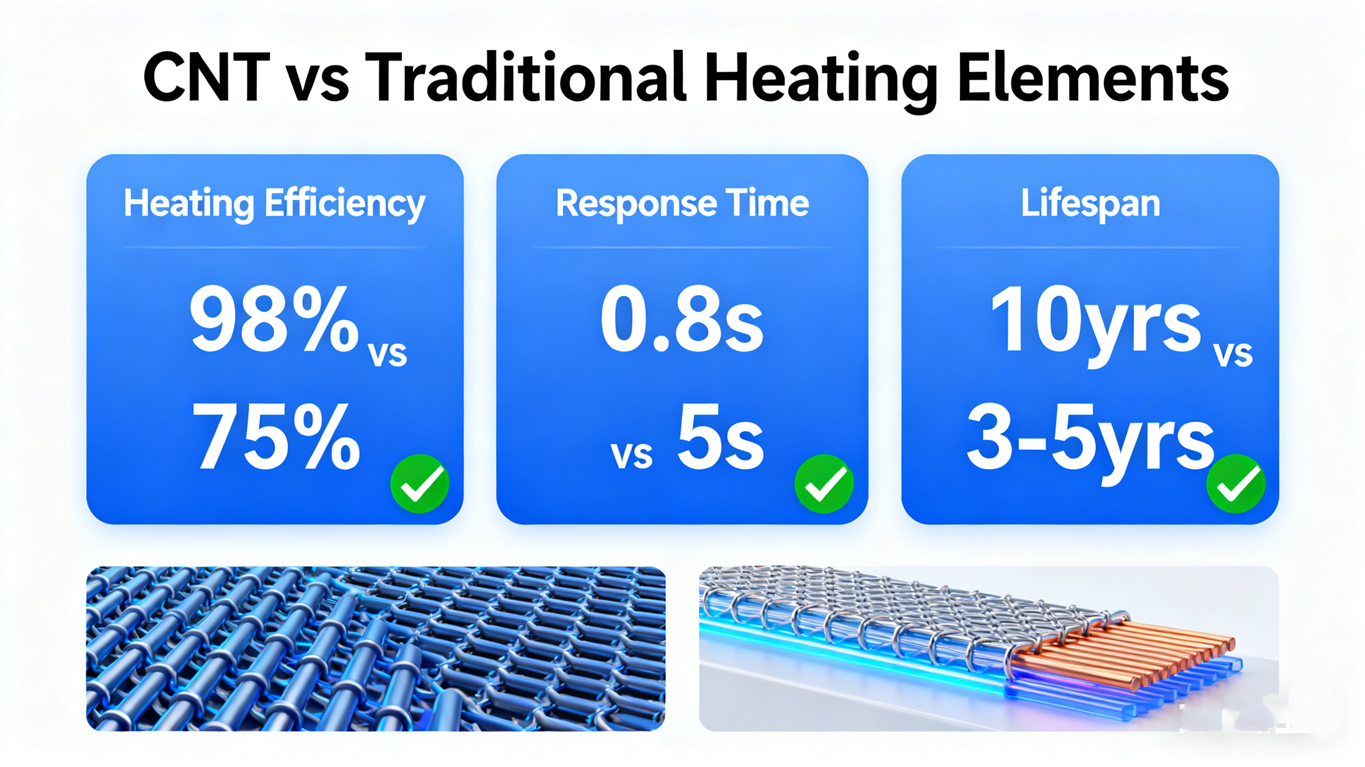
Energy Efficiency Advantage: Carbon nanotube heating blankets save 60% more energy than traditional ones, aligning with the global trend of energy conservation and emission reduction.
Health Functions: Emits far-infrared rays with a wavelength of 6-14μm, promoting blood circulation and relieving muscle soreness to enhance product added value.
Technological Breakthroughs: Mature production processes have increased the yield rate from 75% in 2019 to 92% in 2024, leading to gradual cost reduction.
Policy Support: The EU's Energy Efficiency Directive for Household Appliances (to be implemented in 2026) requires all new heating blankets to meet Level 1 energy efficiency standards, creating market space for carbon nanotube products.
Market Outlook
2026-2027: Large-scale application of graphene-carbon nanotube composite materials is expected, shortening the thermal response time to 0.8 seconds (a 40% improvement).
After 2028: Mature self-healing technology will extend product lifespan by over 50%, further enhancing cost-effectiveness.
Penetration Forecast: By 2030, the penetration rate of carbon nanotube heating blankets in the heating blanket market will increase from the current 3.2% to 12.5%.
Market Characteristics and Investment Value
High Gross Profit Margin: High-end carbon nanotube heating blankets boast a gross profit margin of 45-55%, significantly higher than the 15-20% of traditional heating blankets.
Technological Barriers: Core patents are concentrated in a few enterprises (such as Jartoo and Hanwei), resulting in relatively orderly market competition.
Application Expansion: Beyond heating blankets, carbon nanotube heating technology has extended to smart clothing, medical rehabilitation, automotive seat heating and other fields, with continuous market expansion.
Note: The above data is mainly based on market research reports from authoritative institutions including QYResearch (July 2024), Verified Market Reports (March 2025), and WENKH (April 2025). Some data may be adjusted as the market changes.